
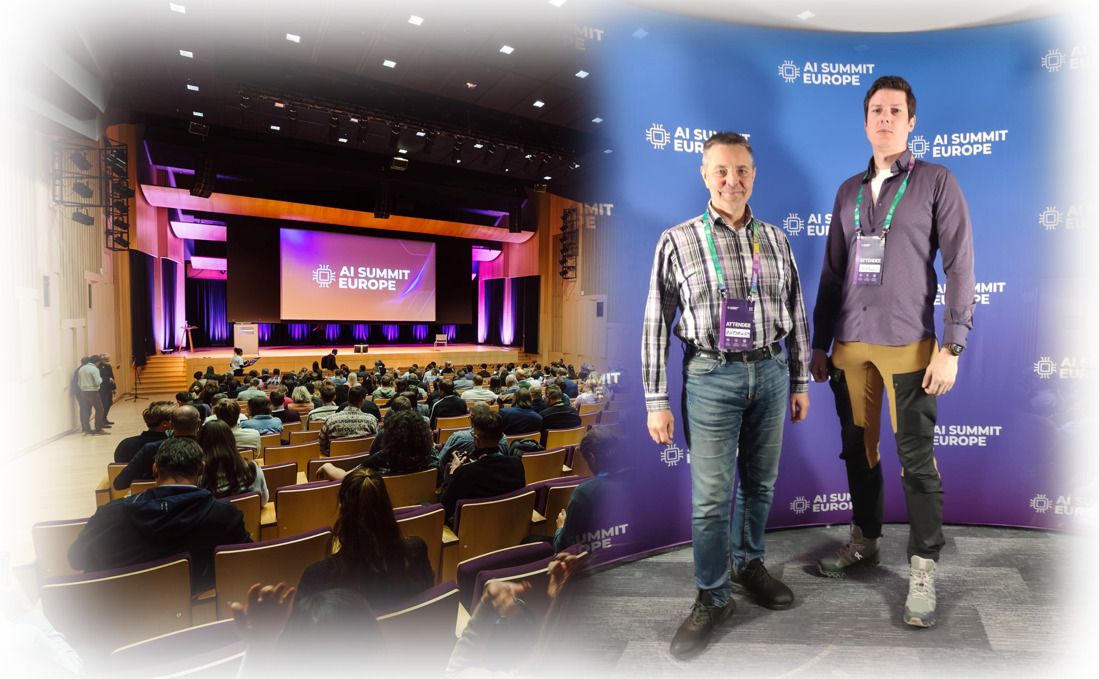
From 6 to 8 May 2026, the international conference “AI Summit Europe” took place in Riga, Latvia. The event was dedicated to leaders ready to take action. It brought together more than 500 participants from over 35 countries. Over the course of three days, more than 40 sessions were held, featuring more than 40 speakers.
The conference was attended, and the content report was prepared, by representatives of the Latvian Data Stewards Network — Nikolajs Būmanis and Jānis Judrups. Participation in the event was ensured within the framework of the project “Support for the Practical Implementation of Open Science, as well as the Development of Solutions for Sharing Scientific Data and Participation in the European Open Science Cloud” (RRF project No. 2.1.3.1.i), with financial support from the European Union Recovery Fund and the Latvian state.
The main focus of the conference was on the practical implementation of artificial intelligence (AI) in organisations, rather than merely on demonstrating technologies. The content presented confirmed a shift from theoretical AI concepts towards measurable and practical value.
Main Thematic Areas and Key Insights
- From the perspective of a data steward, the implementation of AI always begins with a critical question: whether the specific task and the data are actually ready for it. Most AI-related problems are, in fact, connected to governance rather than to the model itself. High-quality and licensed data are currently becoming a strategic resource.
- Data as the foundation of AI: Data quality, provenance, licences and usage rights are of decisive importance. When preparing datasets, filtering, anonymisation, deduplication and strict quality control are essential. Datasets must increasingly be assessed from an “AI-ready” perspective.
- AI agents and the role of humans: AI agents and process automation can effectively perform tasks such as document processing, validation and the preparation of draft decisions. However, they require clearly defined boundaries and responsibilities. Human approval, audit logs and final decision review remain an integral and responsible part of the process.
- Context and language engineering: An organisation’s knowledge layer — including specifications, decisions and tests — serves as the foundation for the successful use of AI tools. Similarly, when working with multilingual content and data descriptions, terminology consistency, the use of glossaries and quality assurance are critical.
- The public sector and accountability: AI governance is a complex issue that involves not only the model, but also infrastructure and responsibility. The main risks to consider are biased data, unclear accountability and insufficient transparency. To ensure institutional visibility in AI-based search, content must be structured, machine-readable and supported by reliable external references.
Application in LBTU’s Work and Future Development
The knowledge gained at the conference provides a direct contribution to the work of Latvia University of Life Sciences and Technologies (LBTU) and its partners.
- “AI-ready” datasets: In preparing datasets, specific requirements for AI readiness will be taken into account by ensuring metadata, provenance, licences and version management for research datasets.
- Support for researchers: Data quality and validation principles will be introduced before the use of AI tools in research. Support will also be provided in assessing risks and defining human review checkpoints.
- Practical assistant: AI tools are planned to be used as support in preparing drafts of data descriptions, summaries, classifications and documentation.
- Training and awareness-raising: Training and consultation materials on the responsible use of AI in research data management will be further developed.
In conclusion, the true value of AI comes from a ready and well-considered AI product, not merely from demonstrating the model itself. A well-organised data environment, clear access boundaries and continued human oversight are the key prerequisites for the successful and safe integration of technologies into academic and research work.
