
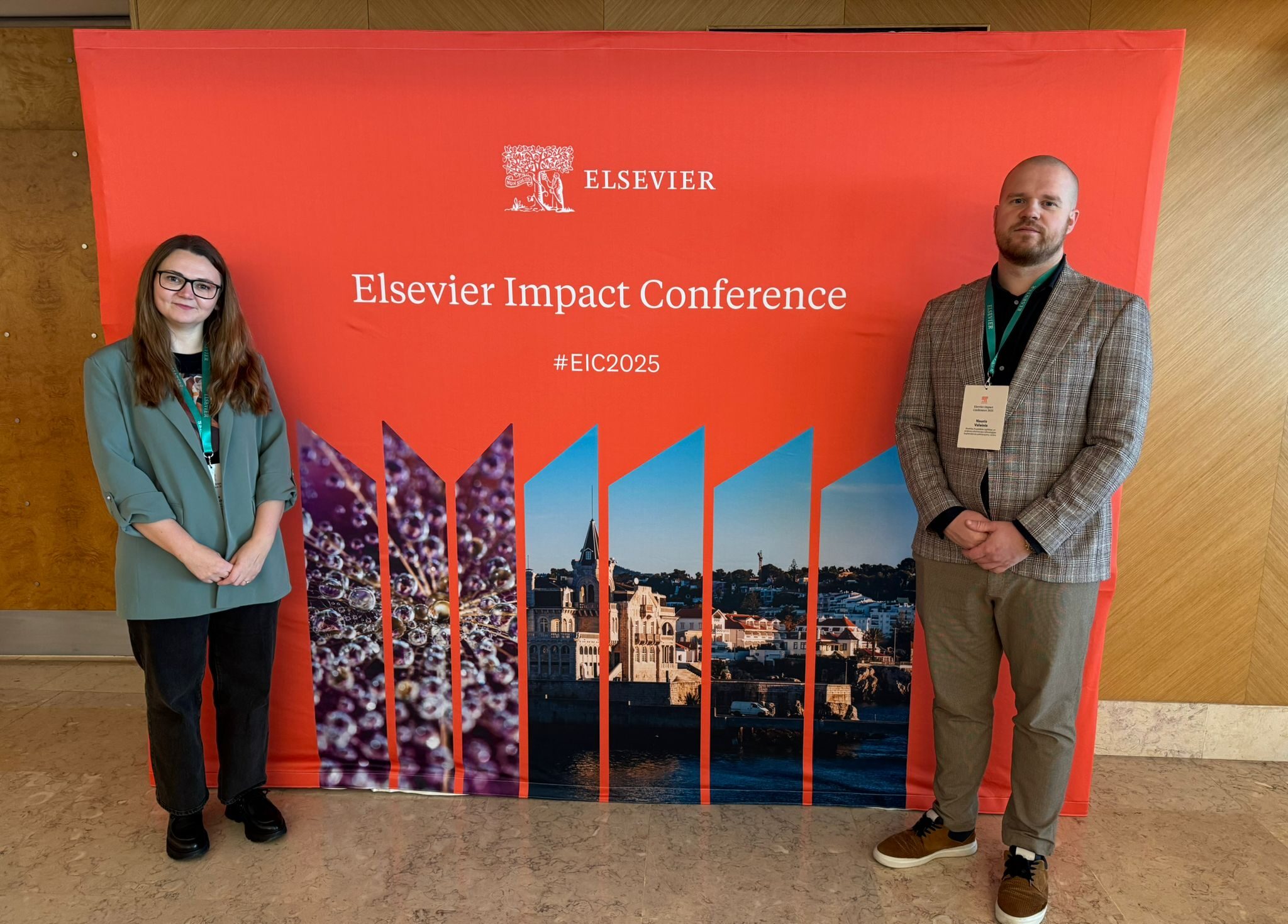
From November 5 to 7, 2025, representatives of the Latvian Data Curators Network, Elza Vecpuise and Nauris Valainis, participated in the Elsevier Impact Conference 2025 and went on an experience exchange visit to NOVA University in Lisbon.
NOVA University in Lisbon is one of the pioneers in Portugal in implementing the Pure system. During the visit, Tiago Guedes, Head of the NOVA Research Information Management Office, shared his almost ten years of experience in implementing, administering, training and using the system for bibliometric analysis and preparing scientific impact reports. T. Guedes recommended investing as much time and resources as possible in the system implementation process and user training, as well as trying to get involved in Pure user communities and clearly define the system’s functionality needs at the university and national level. The knowledge gained during the visit is relevant for data curators in Latvia, who are currently working on integrating the system with the national data repository DataverseLV.
The Elsevier Impact Conference 2025 served as a central platform for uniting the Pure and Digital Commons user communities, promoting strategic collaboration, innovation, and the exchange of experience in the academic and research fields. In the parallel sessions of the conference, participants got acquainted with the latest functionalities of the Pure system, gained insight into the experience of other users in implementing the system, as well as learnt in detail about the most current trends in research management and the future development roadmap of the system, thus significantly strengthening their competence in effective research process management.
The conference sessions presented the latest capabilities for dataset management in the research information system Pure. Integration with datasets at the organisational (based on ROR ID) and researcher (based on ORCID) level. The new “Available Updates” mechanism ensures data synchronisation and metadata quality improvement, while version management allows for the latest version of a dataset to be reflected in a single record.
During the conference, it was particularly emphasised that datasets are increasingly becoming a full-fledged research output alongside publications. Documenting them in CRIS systems, such as Pure, provides a more complete view of an institution’s research activities and data lifecycle. Data registration is also an important part of Open Science – it promotes transparency, reproducibility and data reuse in accordance with the FAIR principles (Findable, Accessible, Interoperable, Reusable). It was also recalled that more and more funders require reporting on datasets and their metadata, so the CRIS system must support the fulfilment of such requirements.
These developments are strategically important for the Latvian research environment, as they coincide with the implementation of the national Pure system and parallel work on integration with the national data repository DataverseLV. Given that DataverseLV assigns DOIs using DataCite, the new Pure – DataCite integration provides critical functionality, automated metadata import from the repository to Pure data module records. This approach provides a double benefit: it significantly reduces manual work and at the same time improves data visibility both locally and internationally, thus significantly strengthening the Latvian open science ecosystem.
