
Principles for organising research project folders
A clear and well-organised folder structure is essential for effective research data management. It is important to develop a folder system that reflects the structure, workflow and responsibilities of the project from the early planning stage. This ensures that data, documentation and results are easy to find, understand and manage throughout the project life cycle and beyond, and that the structure is understandable to people not involved in the project.
Although the specific folder structures may vary according to the type of project, sector, requirements and needs, the recommended approach is to organise the folders according to the main phases of the project.
-
Project administration: e.g. project applications, contracts, budget and financial reports, legal documents
-
Work packages or thematic areas: In large research projects, it is recommended to divide the work packages into or based on specific research questions (e.g. each individual study has its own folder), experimental phases (e.g. pilot study, first experiment, second experiment) or team divisions (e.g. each PhD student involved in the project has its own folder)
-
Research activity or methodology: Research plan or protocol, ethics application, data collection protocols, methodology descriptions, laboratory notebooks, literature reviews
-
Data: Data management plan, data dictionaries/codebooks, different types of data such as raw data, processed data, anonymised data; dataset prepared for publication in a repository (with attached ReadMe file, codebook, etc. with explanatory documentation)
-
Data analysis: Data analysis plan or description, data analysis scripts, codes, intermediate results and visualisations
-
Results and contributions: manuscripts and publications of scientific papers, reports, presentations
-
Archive or trash: Outdated versions of files, drafts and any material that is no longer needed to reduce clutter in active folders
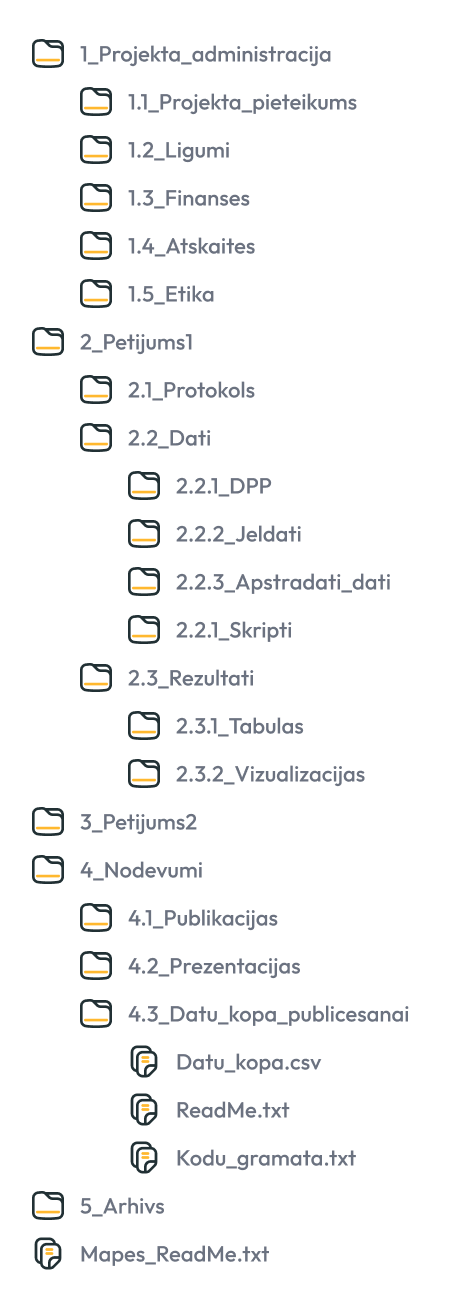
This basic structure depends on the needs of the project, but it is very important to maintain a logical and consistent hierarchy. To ensure clarity, it is recommended to create a folder overview document (e.g. MapesReadMe.txt) that explains the purpose of each main folder and any rules for sub-folder use.
Principles for organising research project folders
A clear and well-organised folder structure is essential for effective research data management. It is important to develop a folder system that reflects the structure, workflow and responsibilities of the project from the early planning stage. This ensures that data, documentation and results are easy to find, understand and manage throughout the project life cycle and beyond, and that the structure is understandable to people not involved in the project.
Although the specific folder structures may vary according to the type of project, sector, requirements and needs, the recommended approach is to organise the folders according to the main phases of the project.
-
Project administration: e.g. project applications, contracts, budget and financial reports, legal documents
-
Work packages or thematic areas: In large research projects, it is recommended to divide the work packages into or based on specific research questions (e.g. each individual study has its own folder), experimental phases (e.g. pilot study, first experiment, second experiment) or team divisions (e.g. each PhD student involved in the project has its own folder)
-
Research activity or methodology: Research plan or protocol, ethics application, data collection protocols, methodology descriptions, laboratory notebooks, literature reviews
-
Data: Data management plan, data dictionaries/codebooks, different types of data such as raw data, processed data, anonymised data; dataset prepared for publication in a repository (with attached ReadMe file, codebook, etc. with explanatory documentation)
-
Data analysis: Data analysis plan or description, data analysis scripts, codes, intermediate results and visualisations
-
Results and contributions: manuscripts and publications of scientific papers, reports, presentations
-
Archive or trash: Outdated versions of files, drafts and any material that is no longer needed to reduce clutter in active folders
This basic structure depends on the needs of the project, but it is very important to maintain a logical and consistent hierarchy. To ensure clarity, it is recommended to create a folder overview document (e.g. MapesReadMe.txt) that explains the purpose of each main folder and any rules for sub-folder use.
