
Copyright and licences
Research results, including datasets, may be protected by copyright and may be accompanied by licences setting out the conditions for future use. Copyright does not apply to the figures and/or facts collected during the research itself, but to the dataset that has been organised and described by the researchers concerned, with their own creative and intellectual input.
Licences define how others may use, share, modify or distribute research results– a dataset, software or any other material produced in the course of research. They help the data custodian to protect intellectual property, and allow the user to understand how the material created can be used, for example whether it needs to be referenced or whether it is allowed to be used for commercial purposes.
To help determine the most appropriate type of licence for the research results, online licence options can be used tool.
Licences dfor clusters
Licensing of research datasets is recommended to make it clear what others can do with the data in case of re-use. Most often, a licence is granted by placing the dataset in a research data repository, such as DataverseLV, Zenodo, etc.
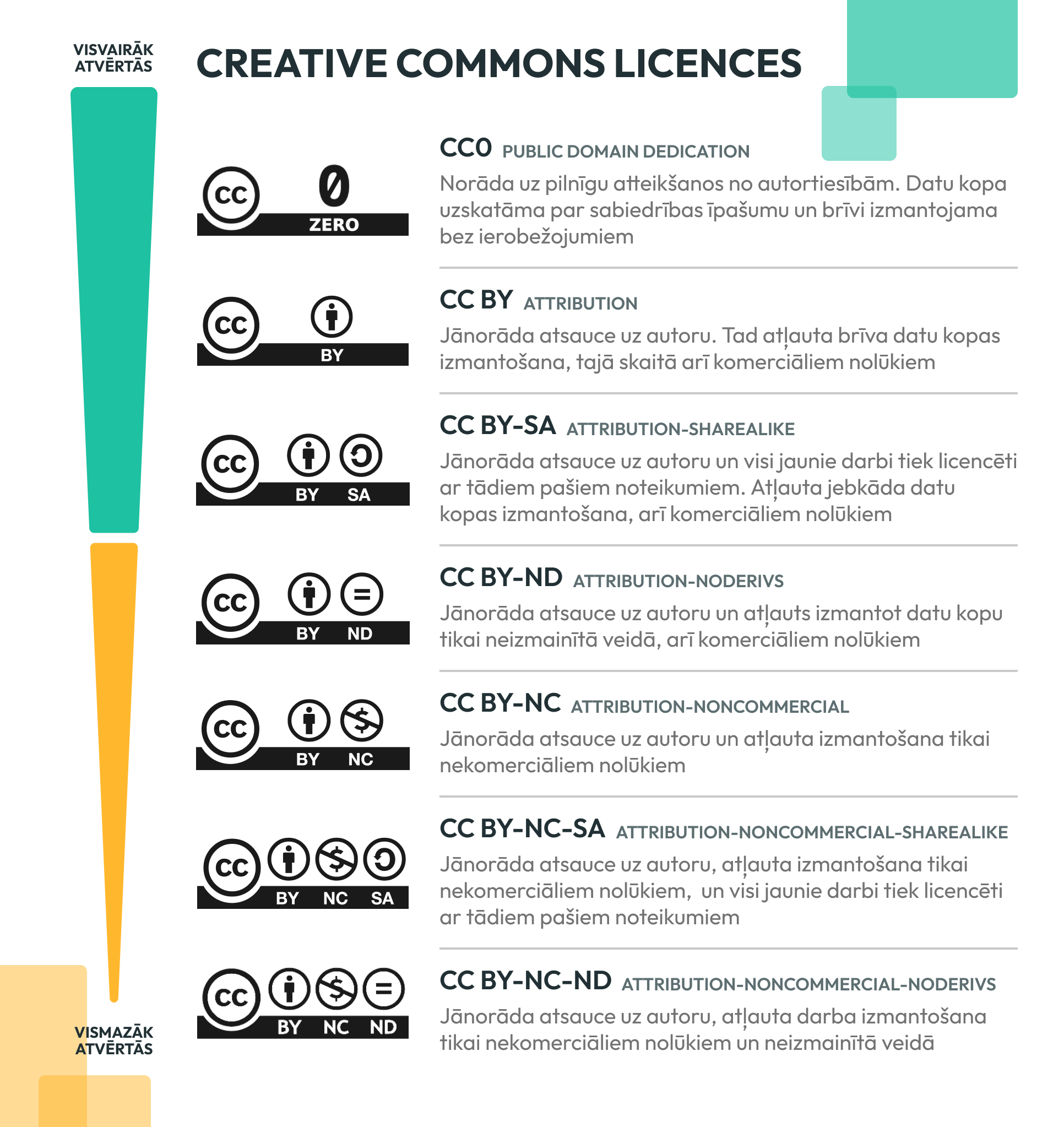
Creative Commons (CC) licences offer a standardised way for authors to grant the public permission to use their works under copyright. The main groups of CC licences are CC0 (public domain) and CC BY (with attribution).
-
Creative Commons Zero Public Domain Dedication (CC0) allows datasets to be published as public domain. They are copyright-free, allowing anyone to use them without restriction – for academic or commercial purposes. The CC0 licence does not require a reference to the author of the original work, but as a matter of academic integrity, it is recommended to ‘attribute’ it. The use of a CC0 licence is seen as the best way to encourage the sharing and re-use of data to support open science
-
Creative Commons Attribution (CC BY) allows you to freely copy, distribute, modify and use the dataset also for commercial purposes – provided you give credit to the author and the source. If authors wish to restrict the terms of use of the dataset, additional terms can be added to the CC BY licence (see below)
Licences pfor software
It is also advisable to grant a licence for software developed for research, to make it clear under what conditions the software can be used in the future.
There are many different licences available for software, depending on whether it is based on original or pre-developed code. When licensing software, you should consider whether you intend to commercialise or patent it.
Open source software (OSS) is particularly important in research: open-source software). The source code of such software is freely available to anyone to view, use, modify and redistribute – in its original or modified form. For open source software, there are different types of licences that determine how the software can be used and distributed.
Software licences fall into two broad categories:
-
Permissive licences: allows you to use, modify and redistribute software, including commercial closed-source products. These licences often have minimum requirements – mainly to preserve the original authorship (e.g, MIT, Apache 2.0, BSD)
-
Copyleft licences: Requires derivative works to be distributed under the same licence– it ensures that the modified code remains open (e.g, GNU, GPL, AGPL)
It is often difficult to determine which licence is the most appropriate. It is advisable to discuss the choice of licence within the research group and to contact support staff at the university or institute if you are unsure.
To get an idea of what licences are available for your software, we recommend using these selection tools:
Copyright and licences
Research results, including datasets, may be protected by copyright and may be accompanied by licences setting out the conditions for future use. Copyright does not apply to the figures and/or facts collected during the research itself, but to the dataset that has been organised and described by the researchers concerned, with their own creative and intellectual input.
Licences define how others may use, share, modify or distribute research results– a dataset, software or any other material produced in the course of research. They help the data custodian to protect intellectual property, and allow the user to understand how the material created can be used, for example whether it needs to be referenced or whether it is allowed to be used for commercial purposes.
To help determine the most appropriate type of licence for the research results, online licence options can be used tool.
Licences dfor clusters
Licensing of research datasets is recommended to make it clear what others can do with the data in case of re-use. Most often, a licence is granted by placing the dataset in a research data repository, such as DataverseLV, Zenodo u. c.
Creative Commons (CC) licences offers a standardised way for authors to grant the public permission to use their works under copyright. The main groups of CC licences are: CC0 (public domain) and CC BY (with attribution to the author).
-
Creative Commons Zero Public Domain Dedication (CC0) allows datasets to be published as public domain. They are not protected by copyright, allowing anyone to use them without restriction – for both academic and commercial purposes. The CC0 licence does not require attribution to the author of the original work, but as a matter of academic integrity, it is recommended to ‘attribute’ it. The use of a CC0 licence is seen as the best way to encourage the sharing and re-use of data to support open science
-
Creative Commons Attribution (CC BY) allows free copying, distribution, modification and use of the dataset, including for commercial purposes – provided that the author and source are acknowledged. If authors wish to restrict the terms of use of the dataset, additional conditions can be added to the CC BY licence (see below)
Licences pfor software
It is also advisable to grant a licence for software developed for research, to make it clear under what conditions the software can be used in the future.
There are many different licences available for software, depending on whether it is based on original or pre-developed code. When licensing software, you should consider whether you intend to commercialise or patent it.
Open source software (OSS) is particularly important in research: open-source software). The source code of such software is freely available to anyone to view, use, modify and redistribute – in its original or modified form. For open source software, there are different types of licences that determine how the software can be used and distributed.
Software licences fall into two broad categories:
-
Permissive licences: allows you to use, modify and redistribute software, including commercial closed-source products. These licences often have minimum requirements – mainly to preserve the original authorship (e.g, MIT, Apache 2.0, BSD).
-
Copyleft licences: Requires derivative works to be distributed under the same licence– it ensures that the modified code remains open (e.g, GNU, GPL, AGPL).
