
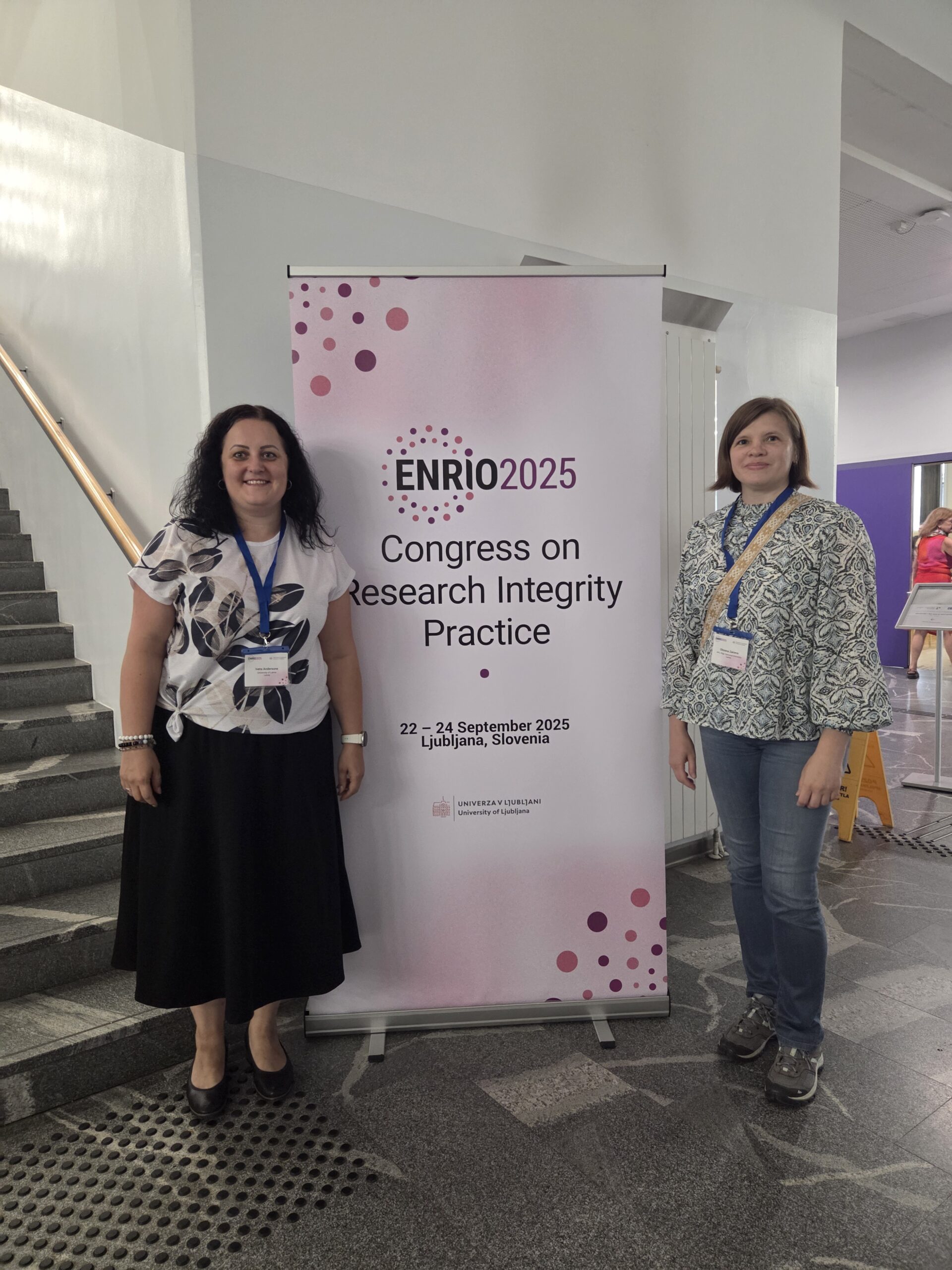
From 22 to 24 September, the ENRIO 2025 Congress on Research Integrity Practice took place at the University of Ljubljana, Slovenia. Two representatives of the Latvian Data Stewards Network attended the congress – Iveta Andersone from the University of Latvia and Oksana Zaiceva from Riga Technical University. The European Network of Research Integrity Offices (ENRIO) unites research integrity offices and institutions in Europe. This year, the congress brought together more than 270 participants from 35 countries to discuss research integrity, power dynamics and a safe institutional culture.
The congress was preceded by a satellite event, where EU projects (IANUS, VERITY, POIESIS and others) focused on strengthening research ethics and public trust were presented. An interesting proposal was to introduce "stewards of trust" – individuals or institutions that help the public distinguish reliable information from disinformation.
In the workshop on open metadata, we learnt how to use the Crossref API. In the workshop on artificial intelligence (AI) ethics, we looked at real cases, including a situation where a lecturer used ChatGPT to determine whether students had used AI in writing a paper and displayed an unsuccessful assessment to the entire audience. In the Beyond Bad Apples workshop, which also included Latvian expert Signe Mežinska, we evaluated guidelines for a paradigm shift in group work – from punishing individual "bad scientists" to solving systemic problems. The "Research Culture" session showed how the European Code, the UNESCO recommendation and the CoARA form a unified vision for responsible research. In the "Publication and Authorship" session, Wouter Vandevelde (KU Leuven) exposed "papermills" – fake journal networks, where 44 out of 50 articles were duplicated with manipulated dates and authors. The "RI and AI" session discussed the ethical use of AI and the development of guidelines. The "Training and Education" session examined training methods – from e-learning courses (Viktor Scholz) to the Open Science Learning GATE platform (Julia Priess-Buchheit, Marie Alavi). There were many other valuable presentations at the congress.
The keynote lectures of the congress were dominated by a sociological perspective. In the "Trust in Science" session, Michel Dubois (Sorbonne University) refuted the myth of a crisis of trust – trust in science is stable. Martin W. Bauer (London School of Economics) asked if there can be "too much" trust. His study on "technocracy tolerance" showed a connection with conspiracy theories. In the "Power Dynamics" session, Roman Kuhar (University of Ljubljana) and Marcela Linkova (Czech Academy of Sciences) analysed power structures – from epistemic power to institutional betrayal in cases of gender-based violence.
The congress offered valuable resources: the Embassy of Good Science platform, VERITY interactive tools and the PREPARED 4P strategy (Ponder – Prepare – Practice – Protect) for the protection of scientists. All results are available online.
Research integrity is relevant for data stewards – data reliability, metadata and access management are part of the integrity processes. The congress provided an opportunity to get acquainted with the latest trends and international experience.
