
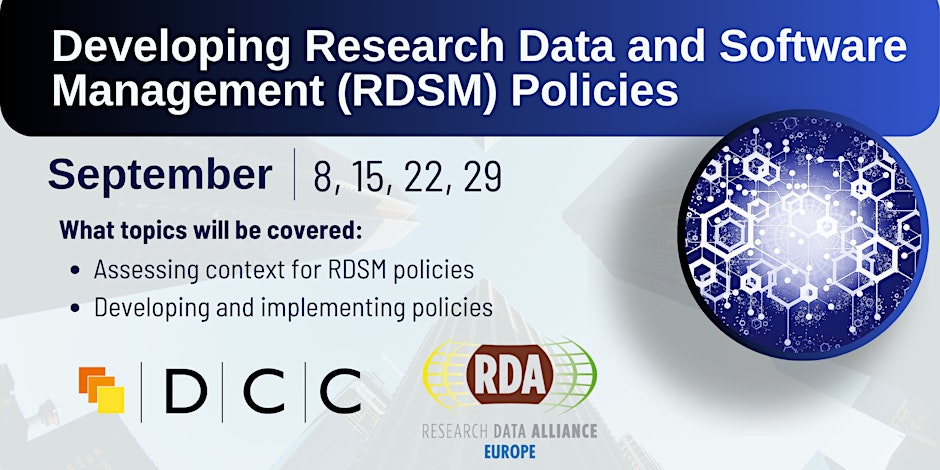
In September of 2025, data stewards Līna Lāže (RSU), Elza Vecpuise (RTU), Iveta Andersone (LU) and Ilmārs Dukulis (LBTU), representing the Latvian Data Stewards Network and major Latvian universities, participated in a specialised four-week online training programme “Developing Research Data and Software Management Policies”. The training was organised by the Digital Curation Centre in cooperation with the European hub of the Research Data Alliance Research Data Alliance Europe.
The training was intended for organisations that want to develop or improve their research data and software management policies. The programme combined theoretical knowledge with practical experience to ensure that the developed policies comply with the FAIR principles (Findable, Accessible, Interoperable, Reusable) and are realistically implementable. The training was organised in 4 weekly sessions, which covered the assessment of the organisational context for policy development and examples of good practice in policy implementation, as well as individual consultations in policy development.
Special attention was paid to the use of specialised tools and resources. Stewards were introduced to the FAIR-enabling Data Policy Checklist, which is the main policy assessment tool and is based on the research and results of the FAIRsFAIR project. This checklist helps to identify policy elements that facilitate the implementation of FAIR principles and also includes three main sections – policy context, FAIR-inclusive content and support mechanisms for researchers.
It was also demonstrated how to use the LEARN KPIs (Key Performance Indicators) developed in the European LEARN project. These key indicators were designed to help assess the success of the implementation of research data management policies. The assessment is carried out by determining the readiness of the institution for data management and looking at the practical implementation of the policies.
During the training, participants analysed examples of good practice from the universities of Oxford, Vienna and Twente, gaining practical insights into different approaches to policy-making. Topics such as stakeholder engagement, communication strategies and policy monitoring methods were discussed. As a result of the sessions, Latvian data stewards have gained a deeper understanding of the integration of FAIR principles into policies, as well as practical tools for policy evaluation and monitoring. This was also a unique exchange of experience in an international and multicultural environment to discuss the future direction of science. This training significantly strengthened the capabilities of Latvian data stewards to support researchers in data management and facilitated the implementation of open science principles at their universities, while at the same time promoting the development of competence and international visibility of the Latvian data stewards network.
